Research
Somewhere between institutionalist political economy, small business and innovation economics and economic history, my research focuses on the institutions involved in the public financing of SMEs and innovation. It focuses on 3 main areas:
- Institutional change in the history of public arrangements for corporate financing.
- The valuation power of public funding and the legitimacy of the organisations and actors behind it.
- The effects of public funding on company trajectories.
On this page you will find a summary of my work in progress, both individual and collective, as well as published works.
Work in progress
The power of public funding. Various funding instruments and their certification effects
Under review.
Abstract
Public agencies finance innovation through a growing variety of instruments, yet we know little about which features of an instrument make its support informative to private financiers. Theories of certification attribute the “stamp of approval” of public funding to selective, expertise-intensive allocation, but the concept is increasingly applied to instruments that satisfy neither condition. We exploit administrative data on three innovation-support instruments administered within a single agency — the French public investment bank (Bpifrance) — between 2014 and 2020: non-competitive innovation grants, competitive innovation contests, and a label granting access to retail innovation funds. Combining genetic matching with staggered difference-in-differences estimators, we find that all three instruments raise recipient firms’ leverage and bank-debt share two years after support, with effects concentrated among younger and smaller firms. The effect arises even for instruments that are neither selective nor expertise-intensive, and the amount of funding does not account for it. The standard signalling account cannot fully accommodate this pattern. We argue that public funding additionally operates through the valuation power that agencies derive from their standing as emanations of the state, and we draw implications for the design of innovation-financing instruments.
Public financing of the economy in a financialised context: A critical literature review
With Marion Tosolini. Under review.
Abstract
Since the 1990s, a growing body of literature has examined the role of the state in the economy within the financialised accumulation regime. However, despite the proliferation of such studies, this literature remains fragmented, with no real attempt to bring coherence to it. This article pursues three objectives. First, it offers a synthetic review of this scholarship and shows that the investor state and derisking state frameworks form part of a single research programme on the public financing of the financialised economy, and that they help to explain the persistence of financialisation despite its well-documented fragilities. Second, we show through two case studies that the instruments of public financing display strong long-term continuity. Third, we argue that what truly characterises financialised public intervention is not the instruments themselves but the techniques through which they operate and their position within the architecture of public action. This article thereby echoes recent calls for periodisations that articulate continuity and rupture rather than collapse one into the other.
Turning environmental values into market value. The entrepreneurial work in the committed production market
With Marion Michel. Under review.
Abstract
This article examines entrepreneurship in the eco-friendly consumer goods sector. Using a mixed-methods approach combining semi-structured interviews, online ethnography and company accounting data, it describes the polarisation of the sector between dynamic SMEs and highly precarious one-person businesses. It explains these differences by the ability of certain entrepreneurs to combine the eco-friendly qualities of their products with the use of market value-enhancing devices (advertising, multiple funding sources).
Peer-reviewed articles
Financing businesses: an affair of state? Rise and financialisation of public financing for small and medium-sized enterprises in France
Abstract
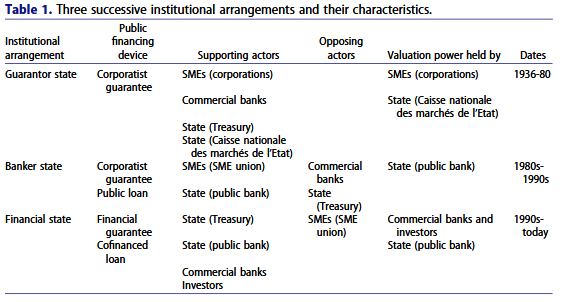
Contemporary economic policies have become increasingly reliant on lending and guarantee instruments managed by public banks. Does this trend signal a return of the state, or rather the financialisation of public action? This article explores the long-term institutional transformations of public SME financing in France, analysing the evolving roles of finance, businesses and the state. Drawing on historical institutionalism and the political economy of financialisation, it examines both the creation and the gradual financialisation of the institutional arrangement governing public SME financing. Based on extensive sources – 108 archive boxes, additional historical materials, and ten semi-structured interviews – the study traces the emergence of a financialised institutional arrangement that has underpinned French economic policy since the late 1990s. Initially centred on public guarantees developed in the interwar period, the introduction of public loans in the 1980s produced a fragile arrangement that ultimately facilitated financialisation through the integration of financial devices and actors. This periodisation based on valuation powers helps to explain the recent conjunction of renewed public intervention and the consolidation of financialisation dynamics.
'Article 8': A Forgotten Government Guarantee Mechanism for Financing SMEs
Abstract
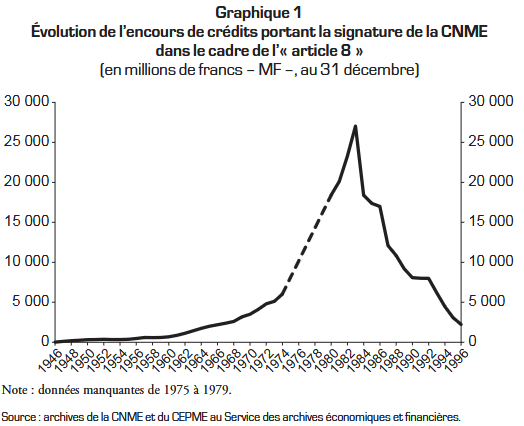
This article analyses the emergence and subsequent decline of Article 8, a public guarantee scheme for SME financing. Created in 1936 and included in the post-war category of medium-term capital expenditure credits that could be drawn on, it grew rapidly in importance during the 1970s, making up as much as 2% of business loans in the early 1980s. Based on the participation of corporatist groups, this mechanism was financially advantageous for the public authorities. We show that its decline and replacement by the current system of publicly guaranteed funds in the 1980s-1990s can be explained by the decline of these corporatist structures inherited from the inter-war period and the decline of the system of credit regulation created after the war in 1945.
Other contributions
Regards croisés sur l’économie is a French economic and socio-economic journal with an editorial board and scientific advisory board, which aims to build bridges between academic research and public debate.
- Monnet E. (2025), “Organiser et financer l’économie de guerre”, interview conducted by Alex Amiotte Suchet and Marion Tosolini, Regards croisés sur l’économie, n° 36, pp. 27-35.
- Amiotte Suchet A. and Yaïche M. (2024), “Géographie de l’innovation : de la théorie à la pratique”, Regards croisés sur l’économie, n° 34, pp. 76-82.
- Amiotte Suchet A., Glass A. and Tosolini M. (2024), “À la recherche de l’innovation. Accumuler, diffuser, légitimer”, Regards croisés sur l’économie, n° 34.
- Amiotte Suchet A. and Régniez T. (2023), “Hyperinflation, déflation, stagflation”, Regards croisés sur l’économie, n° 32, pp. 204-209.